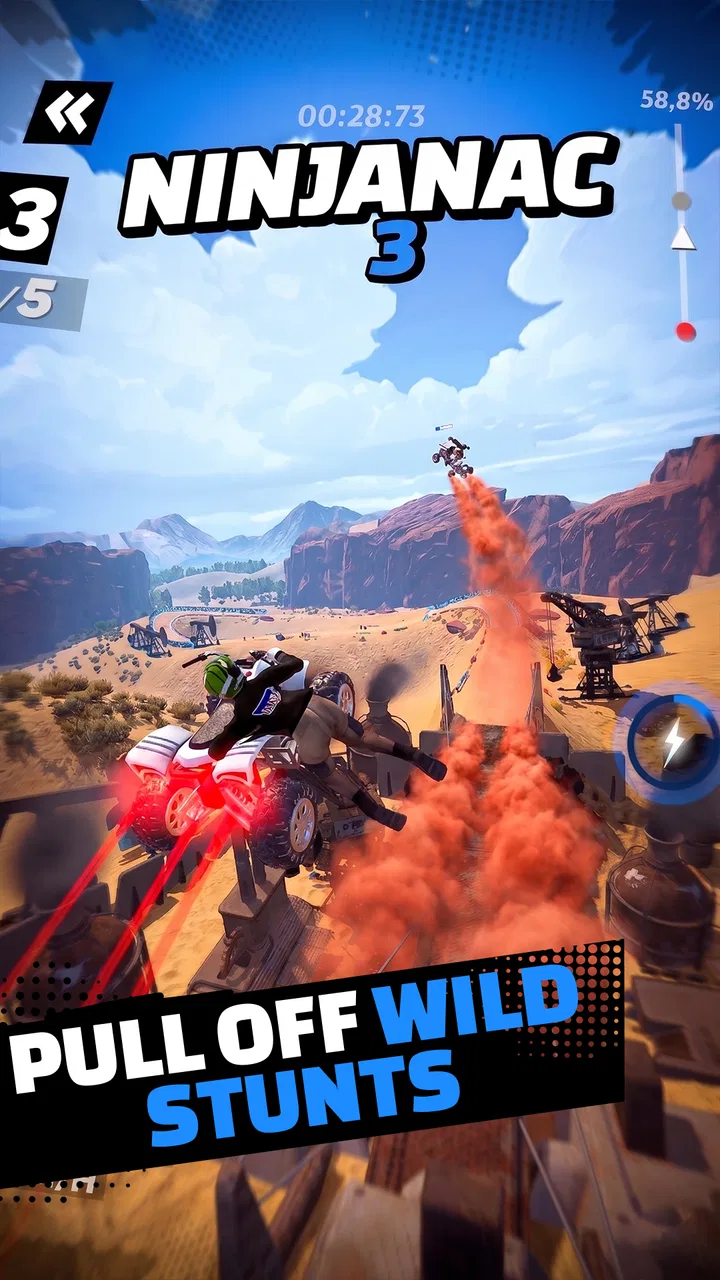
DUST: Dirt ATV Offroad Racing
- 3.5
- Rating
- 50.00K
- Installs
- Free
- Price

 Analysis by App-foxy
DUST: Dirt ATV Offroad Racing is the kind of Android racing game I would open when I want a quick burst of muddy, rough-terrain driving rather than a polished simulation. Its focus is straightforward: control an ATV quad bike through dirt and off-road racing situations, with the appeal coming from unstable ground, aggressive turns, and the feeling of wrestling a lightweight vehicle through a course. I found that simple idea more interesting than the short store wording suggests, because off-road racing depends less on perfect road lines and more on how well you react when the surface refuses to behave.
Developed by Vira Games Inc., this free racing game is aimed at a broad audience and carries an Everyone age rating. It has reached over 50 thousand installs, while its average score sits at 3.5 from around 40 ratings. That combination tells me to approach it as a compact, still-developing game rather than a major racing release with a large established community. The current version is 1.0.9, and it runs on Android 7.1 or later, which makes it accessible to many older devices.
My overall reaction is mixed but positive in the right situation. I like the direct off-road identity, the fact that the game is free to start, and the way an ATV naturally creates a different driving rhythm from a sports car. At the same time, anyone expecting the depth of a full console-style racer, a broad competitive ecosystem, or clearly documented spending mechanics should slow down before installing. This is best approached as a casual dirt-racing game, not as a complete motorsport platform.
You May Also Like

 Blood Strike: 2.5 Anniversary
Blood Strike’s Loadouts Turn Every Drop Into a Tactical Gamble
A close look at Blood Strike’s custom loadouts: how fast access to signature weapons reshapes its battle royale rhythm, rewards preparation, and narrows the gap between fights.

 Pandora - Music & Podcasts
Pandora’s Music Is Easy to Start, but Harder to Recover
Pandora’s strength is its low-effort path from a seed to a station. Its weak spot is how much confidence it asks you to place in connection, setup, and quiet recovery.

 8 Ball Pool
 Is Built on Rivalries, Rematches, and Routine
A close look at the rivalries, rematches, shared routines, and unanswered safety questions that turn a quick pool match into a persistent mobile community.

 Samsung Music
’s Quiet Strength Is Playing What You Already Own
Its reach comes less from spectacle than from dependable access to a personal library. That simplicity is both the app’s strongest retention engine and its ceiling.

 AccuWeather: Weather Radar
AccuWeather Review: A Quick, Clear Forecast for Everyday Decisions
For everyday plans, the best forecast is the one you can understand quickly. AccuWeather makes rain timing, radar, and local conditions easy to act on, with a few trade-offs.

 Hill Climb Racing
Why Hill Climb Racing Still Turns Crashes Into One More Run
A tiny car, a bumpy hill and one more upgrade: Hill Climb Racing keeps resurfacing because its simple chaos makes every near-miss feel personal.
More From Our News Desk
View All News


What the ATV focus changes during a race
The ATV is not just a visual theme. A quad bike makes the racing fantasy feel more physical because the vehicle seems suited to loose soil and uneven ground. In a conventional road racer, I usually think about braking points, clean apexes, and maintaining a smooth racing line. Here, the imagined priorities are different: keeping control through mud, carrying enough momentum into rough sections, and avoiding the panic that comes when a turn arrives while the vehicle is already unsettled.
That distinction gives DUST a useful identity. Many mobile racing games lean toward supercars, traffic dodging, or bright arcade tracks. This one asks for a more rugged mood. If you enjoy the visual and mechanical idea of mud racing more than polished asphalt, the premise should feel immediately appealing. It is also easier to understand than a game built around a large collection of menus, licenses, and vehicle classes. You start with the central fantasy: ride an ATV, attack an off-road course, and try to finish ahead.
For a first session, I would resist the temptation to drive as if the track were a normal circuit. Off-road racing rewards anticipation. I would watch the shape of the route before committing to a turn, make smaller corrections instead of repeatedly dragging from side to side, and treat every muddy section as a place where control matters more than raw speed. Even when a game is designed for quick play, this kind of deliberate approach makes the ATV feel less like a sliding icon and more like a vehicle that needs managing.
A practical routine for short sessions
A realistic use case is a ten-minute break between errands or during a commute when you have enough time to play but do not want to learn a complex career system. I would use the first attempt on a course to identify where the surface or layout causes trouble, then use the next attempt to improve one specific decision. For example, instead of chasing a perfect finish immediately, I would focus on entering the mud section with a stable line and leaving it without a large correction.
This approach matters because casual racers can become frustrating when every mistake feels random. The most useful habit is to separate a driving error from a course surprise. If I lose control because I turn too sharply, I can change my input. If the game gives me a section that is difficult to read on a small screen, I need to slow down and learn its visual cues. That small distinction turns repeated attempts into practice rather than simple repetition.
I would also recommend playing with a clean screen and a comfortable grip. Off-road racing depends on seeing the route early, and fingers can easily cover the area where I need to judge the next bend. This is not a hidden feature or a technical trick; it is simply a practical way to reduce avoidable mistakes in a game where quick corrections are likely to matter.
Where the free entry point helps
The free price is important for this particular type of game. An ATV off-road racer is a niche preference, and I would not want to pay before discovering whether its handling style suits me. Being able to try the central driving idea without an upfront purchase lowers the risk for someone who is curious about dirt and mud racing but normally chooses road-based games.
However, free does not automatically mean frictionless. The store information establishes that the game costs nothing to download, but it does not establish a purchase structure, upgrade economy, advertising frequency, or whether progress can be accelerated with spending. I would therefore avoid promising a completely payment-free experience. The sensible approach is to install it as a trial, observe how the game presents any optional spending, and decide whether the driving remains enjoyable without paying.
That is also where the current rating deserves context. An average of 3.5 is neither a clear warning nor a strong endorsement. With only a few dozen ratings, the score can move as more players arrive. I would treat it as a reason to keep expectations moderate, not as proof that the game is poor. The install count shows that people are finding it, but popularity alone does not tell me whether its controls, pacing, or monetization will suit every player.
Progress, pressure, and the question of spending
When I judge a mobile racer, I pay attention to the pressure it puts on the player. A game can be mechanically simple yet still feel demanding if it constantly pushes upgrades, repeated retries, or purchases. With DUST, the verified public details confirm the free entry price and the current release version, but they do not establish the exact progression systems or any required payments. That means I can assess the decision-making clearly, but I should not pretend to know how every later session is structured.
For a new player, the best test is to notice what the game asks you to repeat. If improvement comes mainly from learning the route and handling the ATV better, that is a healthy form of pressure: the player is rewarded for skill. If progress instead becomes dependent on waiting, repeatedly replaying content, or buying advantages, the experience may feel less satisfying. I would make that judgment after a few sessions rather than after the opening race, because early sections often do not reveal the long-term balance.
A useful personal rule is to set a stopping point before frustration takes over. If I fail the same section several times, I would pause and ask whether I am learning a better line or merely repeating the same input. This protects the game from becoming a reflexive retry loop. It also reveals whether the challenge is fair: a fair obstacle usually becomes more manageable when I change my approach.
How to evaluate upgrades without guessing
If the game presents vehicle improvements or other progression choices, I would compare them by function rather than by appearance. A faster ATV is not automatically better if it becomes harder to control in mud. A handling improvement may be more valuable for a player who regularly misses corners, while extra speed may help someone who already keeps a stable line. The right choice depends on the course problems I am actually experiencing.
This is one of the more important trade-offs in an off-road racer. On a smooth circuit, speed can dominate the conversation. On dirt, control and acceleration may matter just as much because a mistake costs momentum. I would avoid spending anything until I understood which weakness was holding me back. If an upgrade system exists, buying blindly can make the game feel more complicated without solving the real problem.
I would also check whether progress feels optional or compulsory. A good casual session should let me enjoy the driving even when I am not chasing the strongest possible ATV. If the game makes every later attempt feel impossible without improvement, that changes the value of the free download. Since the available facts do not document the full purchase or progression design, this is an area where my recommendation remains conditional: try the handling first, then judge the pressure from actual play.
Who should skip it
I would skip DUST if my main goal were licensed cars, realistic vehicle physics, deep tuning, or a large online racing community. The ATV-and-mud identity is the reason to choose it, so players who prefer clean asphalt and predictable grip may find the rough-terrain concept less enjoyable. I would also look elsewhere if I wanted a game with a clearly documented competitive ladder or a long-term collection system.
It may not be the best fit for someone who dislikes repeating a course to learn its difficult sections. Off-road racing naturally involves trial and correction, and the appeal depends on accepting that some attempts will be messy. On the other hand, players who enjoy compact arcade games and do not need a huge amount of content to justify an install may find the narrower focus refreshing.
Fairness, competition, and what can honestly be judged
Fairness in a racing game has two sides. The first is driving fairness: whether success comes from reading the track and controlling the ATV. The second is economic fairness: whether spending gives a player an advantage that changes competition. DUST’s public facts confirm that it is free and identify Vira Games Inc. as the developer, but they do not establish multiplayer rules, competitive modes, purchase options, or paid advantages. I cannot responsibly label it pay-to-win or claim that it is entirely free of monetization pressure.
What I can say is that the game should be judged first as a driving experience. If I can improve by choosing a better line, braking earlier, and making calmer corrections, then the core challenge feels meaningful. If a race is lost because the ATV behaves inconsistently or because progress is locked behind spending, that is a different kind of frustration. I would pay attention to whether the game explains why I failed, because clear feedback is one of the simplest signs that a racing challenge is being presented fairly.
Compared with the usual alternatives, DUST occupies a smaller and more specific space. A standard arcade racer may offer faster cars and more immediately dramatic speed, while a simulation-oriented title may provide greater control over setup and technique. DUST’s potential advantage is atmosphere and focus: an ATV on dirt can make each turn feel rougher and less predictable. Its likely limitation is breadth. A focused off-road game may be more memorable than a generic racer, but it may not offer the variety that keeps a larger racing title interesting for months.
For players comparing it with another free racing game, I would use a simple test. Ask which experience you want during a short session: clean, high-speed competition on familiar road surfaces, or a more rugged ride where traction and route reading are central. Choose DUST for the second answer. Choose the alternative for the first. That decision is more useful than comparing screenshots or install counts because it matches the game to the way you actually play.
Questions I would answer before installing
Will it run on an older Android phone? The listed minimum operating system is Android 7.1, so devices meeting that requirement are within the stated compatibility range. That does not guarantee identical performance on every handset, particularly when screen size and hardware differ, but it does make the game accessible beyond only recent phones.
Is it suitable for children? The age classification is Everyone, which makes it broadly suitable from a content-rating perspective. I would still use normal family judgment around screen time and any purchase prompts that may appear in a free game. The rating describes content suitability; it does not promise a particular difficulty level or a completely pressure-free experience.
Does the rating prove that it is reliable for everyone? No. The 3.5 average comes from around 40 ratings and a small number of written reviews, so it offers an early impression rather than a definitive verdict. I would read it as evidence that experiences are mixed enough to justify trying the game personally.
Is it a good choice for competitive players? Only if the game’s actual modes and progression satisfy what you want. The available product facts do not establish a deep competitive structure, so I would not install it expecting an esports-style environment or a guaranteed online rivalry. It is safer to approach it as a focused racing game and let the practical experience determine whether it offers enough challenge.
Is paying necessary to enjoy it? The download price is free, but the publicly confirmed details do not establish the complete purchase design. I would begin without spending, see how the early driving feels, and only consider optional purchases if they are clearly explained and genuinely improve enjoyment rather than compensate for an artificial obstacle. That keeps the decision in the player’s hands.
My trust verdict after weighing the trade-offs
The release date of May 28, 2026 and version 1.0.9 place DUST in a relatively early stage of its life, so I would expect the experience to be judged not only by its current driving but also by how consistently it develops. I would keep the game updated and revisit it if later changes improve clarity, handling, or progression. At the same time, I would not buy into promises about a long future or assume that every missing detail will eventually become a major feature.
My recommendation is therefore specific. Install DUST if you want a free ATV racer with a dirt-focused identity, you enjoy learning rough tracks through repeated attempts, and you are comfortable evaluating the spending model for yourself. It is especially suitable for short sessions where the goal is a quick off-road challenge rather than a full career. The older Android requirement also makes it worth considering for players whose phones cannot run newer racing releases.
I would pass if I need a polished, content-heavy racing ecosystem, a guaranteed competitive mode, or complete transparency about purchases before downloading. Those are reasonable expectations, but they point toward a different kind of game. DUST’s strongest idea is narrower: put me on a quad bike, make the ground troublesome, and let me improve through better control.
In the end, I see it as a promising casual experiment with a clear theme, not a universal replacement for every mobile racer. The free entry point makes trying it sensible, while the modest rating and limited public detail make measured expectations important. My trust verdict is “try it, but judge the pressure and fairness in your own first sessions.” If the ATV handling makes you want to take another run because you understand what went wrong, the game has done its job. If each retry feels unclear or financially pressured, your time is better spent with a more established racing alternative.
FAQs for DUST: Dirt ATV Offroad Racing
01What is DUST: Dirt ATV Offroad Racing?
DUST: Dirt ATV Offroad Racing is an off-road racing game focused on ATV riding across rough, dusty tracks. Players compete on challenging dirt courses filled with jumps, uneven terrain, sharp turns, and obstacles. The game is designed for quick races and arcade-style fun, making it suitable for players who enjoy motocross, quad-bike, and action racing experiences on mobile devices.
02How does the gameplay work in DUST: Dirt ATV Offroad Racing?
The main objective is to control your ATV, maintain speed, navigate difficult terrain, and reach the finish line ahead of your opponents. Races typically require a balance between acceleration, steering, landing jumps safely, and avoiding crashes. The controls are built for touchscreens, so new players may need a few attempts to become comfortable with turning, timing jumps, and keeping the vehicle stable.
03Can I play DUST: Dirt ATV Offroad Racing offline?
DUST: Dirt ATV Offroad Racing may be playable without a continuous internet connection for some of its core racing features, but availability can depend on the version installed and the device platform. Internet access may still be required for advertisements, updates, synchronization, leaderboards, or optional online features. It is best to launch the game once while connected before relying on it during travel or offline play.
04Is DUST: Dirt ATV Offroad Racing free to download and play?
The game can generally be downloaded without an upfront purchase, although the exact availability and pricing may differ between Android and iOS. Free versions may include advertisements, optional purchases, or progression systems that allow players to unlock upgrades and other content. Before downloading, check the store listing for current in-app purchase details, permissions, age rating, and any device compatibility requirements.
05What devices are compatible with DUST: Dirt ATV Offroad Racing?
Compatibility depends on the operating system version, hardware performance, available storage, and the specific release published for Android or iOS. Devices with a recent operating system and a capable processor should provide a smoother experience, especially during fast races and visually detailed environments. Check the official app-store page before installing, since supported versions and requirements can change with future updates.
Pros
- Responsive ATV controls make jumps and drifts easy to manage.
- Short races suit quick gaming sessions on mobile devices.
- Multiple off-road environments keep the scenery from feeling repetitive.
- Vehicle upgrades add progression beyond simply completing races.
- Offline play is convenient when no internet connection is available.
Cons
- Some tracks can feel repetitive after extended play.
- Later races may require substantial grinding for competitive upgrades.
- Touch controls can be imprecise during fast turns and jumps.
- Visual quality varies noticeably across different devices.
- Ads or in-app purchases may interrupt the overall racing experience.

DUST: Dirt ATV Offroad Racing
Gallery